
 Written by
(TAKE QUIZ AT END TO SCORE DISCOUNTS.)
STOP WHAT YOU ARE DOING. RIGHT NOW. POUR A CUP.
It doesn’t matter if it’s the Harvest Moon pumpkin spice or the Bean in Your Eye Caribbean blend – just get something hot in your hand, because something historic is happening in space today.
Today – Monday, April 6, 2026 – four human beings are flying past the Moon.
Not landing. Flying around it, around the far side, at a closest approach of just 4,070 miles from the lunar surface. The spacecraft is called Orion. The mission is called Artemis II. And it is the first time humans have traveled this far from Earth since Apollo 17 in December 1972.
That’s 54 years of humans staying close to home. Today, that streak ends.
WHO IS UP THERE?
The Orion spacecraft – officially named Integrity – launched from Kennedy Space Center on April 1, 2026 aboard NASA’s SLS (Space Launch System) rocket. Yes, April Fools’ Day. NASA confirmed: not a joke.
The crew of four:
Commander Reid Wiseman – NASA astronaut, veteran ISS commander
Pilot Victor Glover – NASA astronaut, first Black astronaut on a lunar mission
Mission Specialist Christina Koch – NASA astronaut, record-holder for longest spaceflight by a woman
Mission Specialist Jeremy Hansen – Canadian Space Agency astronaut, first Canadian to fly a lunar mission
WHAT HAVE THEY BEEN DOING UP THERE?
Artemis II is not a sightseeing trip. Every system gets tested. Every procedure gets practiced. This is the shakedown flight that paves the way for a Moon landing on Artemis III.
On Day 2, the crew completed the most important burn of the mission: the Translunar Injection (TLI) burn. Orion’s main engine fired for five minutes and fifty seconds, consuming about 1,000 pounds of fuel to break out of Earth orbit and aim for the Moon. The engine produces up to 6,700 pounds of thrust — enough to accelerate a car from 0 to 60 mph in 2.7 seconds.
On Day 4, astronauts Christina Koch and Jeremy Hansen took turns manually piloting the spacecraft – testing its handling in deep space. For 41 minutes, they put the ship through its paces across two thruster modes.
They also tested their Orion Crew Survival System spacesuits – putting them on, pressurizing them, performing leak checks. You know, just making sure the thing keeping you alive in the void of space actually works. Good call.

FACTS – SIP ON THESE:
🚀 Launch date: April 1, 2026 — 6:35 p.m. EDT, Kennedy Space Center
🚀 Spacecraft name: Orion Integrity — 63-foot solar array wingspan when deployed
🚀 Closest approach to the Moon: 4,070 miles from the surface
🚀 Maximum distance from Earth: 252,760 miles — a new human spaceflight record
🚀 Total mission distance: 695,081 miles from launch to splashdown
🚀 Splashdown target: Off the coast of San Diego, April 10, 2026
🚀 Last time humans were this far from Earth: Apollo 17, December 1972
THE FLYBY: WHAT IS HAPPENING TODAY
Today is the big moment. Orion swings around the far side of the Moon – the side we never see from Earth – using the Moon’s gravity to whip the spacecraft back toward home. This is called a free-return trajectory. If anything goes wrong and the engines can’t fire, the Moon’s gravity still flings Orion back toward Earth. Engineered redundancy. Smart.
During the flyby, the crew has 30 science targets to photograph and study. One highlight: the Orientale Basin – a nearly 600-mile-wide crater that formed 3.8 billion years ago when a massive object slammed into the Moon. It straddles the near and far sides of the lunar surface and will be fully illuminated during today’s pass.
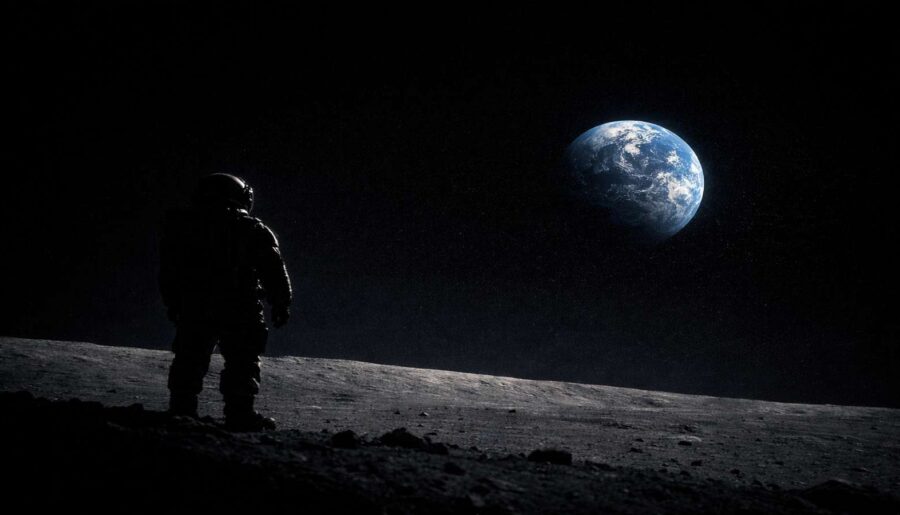
The crew is also attempting to recreate one of the most iconic photographs in human history – the Earthrise photo from Apollo 8 in 1968. That image showed Earth rising over the lunar horizon: a fragile blue marble floating in black. The Artemis II crew will try to capture their own version during today’s flyby.
THE PHILOSOPHY ANGLE – THINK ABOUT THIS
Here at Zombie Buzz, we don’t just drink coffee. We think with it.
There is a concept called the overview effect – a documented psychological shift that astronauts experience when they see Earth from space. The borders disappear. Conflicts look small. The planet looks fragile and precious. Every astronaut who has described it says the same thing: it changes you.
Now imagine seeing Earth not from low orbit – where the International Space Station sits, just 250 miles up – but from 252,760 miles away. Earth becomes a dot. A pixel.
The philosopher Blaise Pascal wrote that the silence of infinite spaces frightens him. He was talking about the universe revealing its scale – making us feel small against the vastness. Artemis II is doing that in real time. Four humans are out there right now, staring at a tiny glowing dot that contains every person they have ever loved, every city, every war, every cup of coffee ever brewed.
That is worth a moment of quiet. And a good cup.
WHAT COMES NEXT?
Artemis II does not land on the Moon – but it makes a Moon landing possible. Artemis III will be the mission that lands on the lunar surface, targeting the Moon’s South Pole where water ice is believed to exist in permanently shadowed craters.
Water ice on the Moon = rocket fuel + drinking water + oxygen. That matters – not just for lunar exploration, but for eventual missions to Mars.
Artemis II proves the hardware works with humans aboard. So far? All systems are go.
DRINK. THINK. LEARN. EARN.
Zombie Buzz Coffee supports lifelong learning and the exploration of big ideas. Whether it’s philosophy, artificial intelligence, or the cosmos – sip up and stay curious.
LEARN AND EARN ZOMBIE BUZZ DISCOUNTS…
QUICK QUESTIONS: SCORE COFFEE DISCOUNTS.
Take a quiz now! Get shop discounts!
-
Product on sale
 Ben-ana Republic – Premium Banana Blend (8 oz.)Original price was: $13.99.$12.99Current price is: $12.99.
 -
Product on sale
 Red, White and Blueberry – Premium Blueberry Blend (8 oz.)Original price was: $13.99.$12.99Current price is: $12.99.
 -
Product on sale
 Red, White, and Blueberry Trio: Let Freedom and Flavor Ring! (3 pack of Blueberry 8 oz. each)Original price was: $38.99.$36.99Current price is: $36.99.
 -
Product on sale
 Independence Brew Trio: Savor the Freedom in Every Sip! (Blueberry, Jamaican, Caribbean) 8 oz.Original price was: $38.99.$36.99Current price is: $36.99.
 -
Product on sale
 2026 Fall Flavor Pack – Premium Pumpkin Spice, Caribbean and Jamaican Blends (8 oz. each)Original price was: $39.99.$35.99Current price is: $35.99.
 -
Product on sale
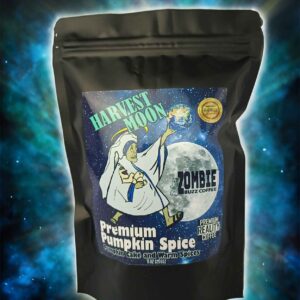 Harvest Moon – Premium Pumpkin Spice Blend (8 oz.)Original price was: $13.99.$12.99Current price is: $12.99.
 -
Product on sale
 Bean In Your Eye – Premium Caribbean Blend (8 oz.)Original price was: $13.99.$12.99Current price is: $12.99.